The Federal Government has unveiled the detailed allocation of the 2026 Appropriation Bill to Ministries, Departments and Agencies (MDAs), with major spending directed at defence, infrastructure, economic management and governance.
A breakdown of the figures shows that the Federal Ministry of Finance tops the allocation chart with ₦16.78 trillion, reflecting government’s focus on debt servicing, fiscal operations and economic stabilisation.+See more details
This is followed by the Ministry of Budget and Economic Planning, which received ₦9.10 trillion, while the Ministry of Works was allocated ₦3.49 trillion to drive large-scale infrastructure development nationwide.
The Ministry of Defence secured ₦3.15 trillion, underscoring the Federal Government’s sustained commitment to tackling insecurity and strengthening national defence architecture.
Similarly, the Office of the National Security Adviser received ₦664.12 billion, while the Ministry of Police Affairs was allocated ₦1.33 trillion.
The Presidency and the National Assembly were allocated ₦355.1 billion and ₦344.85 billion respectively, while the Judiciary received ₦341.63 billion, reflecting constitutional funding provisions for key arms of government.
In the social sector, Education received ₦2.40 trillion, while Health and Social Welfare was allocated ₦2.15 trillion, as the government seeks to improve human capital development and healthcare delivery.
The Ministry of Agriculture and Food Security got ₦1.45 trillion to boost food production and address food security challenges.
Other notable allocations include ₦1.11 trillion for the Ministry of Power, ₦1.35 trillion for the Ministry of Niger Delta, ₦460.74 billion for the Federal Capital Territory Administration, and ₦462.66 billion for the Ministry of Humanitarian Affairs and Poverty Alleviation.
Electoral and governance institutions were also significantly funded, with the Independent National Electoral Commission (INEC) receiving ₦1.01 trillion, while the National Sports Commission got ₦206.43 billion.
Smaller but strategic ministries such as Tourism, Arts, Culture and Creative Economy, Solid Minerals Development, and Livestock Development received allocations ranging from ₦10.4 billion to ₦156.34 billion, reflecting government’s diversification drive.
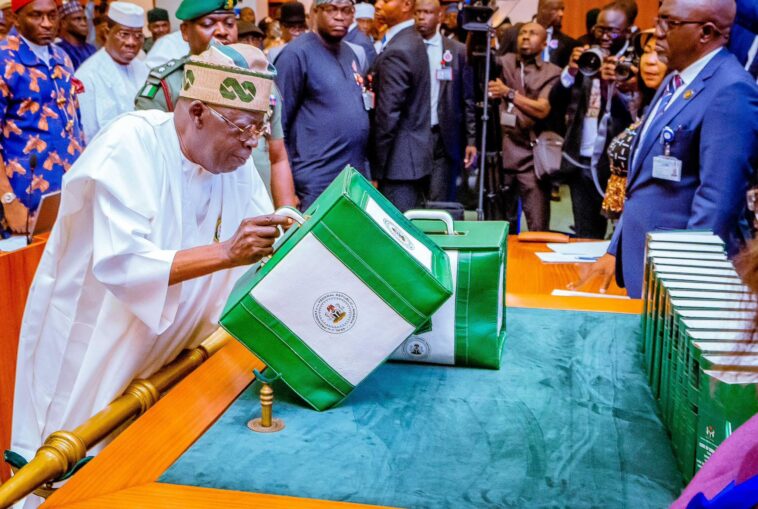
President Bola Ahmed Tinubu had earlier described the ₦58.47 trillion 2026 budget as a reform-driven fiscal plan designed to strengthen security, stabilise the economy, expand infrastructure and improve the welfare of Nigerians.
The budget is currently before the National Assembly for legislative consideration and passage.+See more details
Get Breaking News Before Everyone Else — Join Our Whatsapp Channel Now!!!
𝗙𝗼𝗹𝗹𝗼𝘄 𝗢𝘂𝗿 𝗪𝗵𝗮𝘁𝘀𝗔𝗽𝗽 𝗖𝗵𝗮𝗻𝗻𝗲𝗹 𝗧𝗼 𝗚𝗲𝘁 𝗟𝗮𝘁𝗲𝘀𝘁 𝗡𝗲𝘄𝘀 𝗔𝘀 𝗜𝘁'𝘀 𝗗𝗿𝗼𝗽!