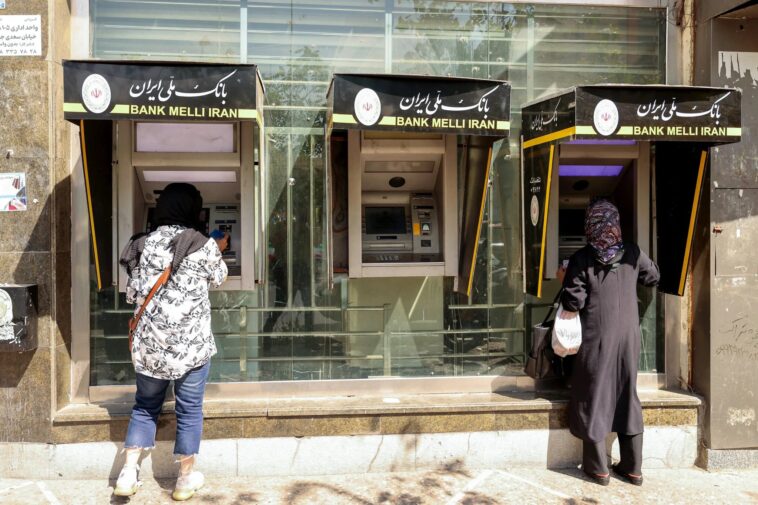
Reports circulating from Iranian activists and citizens describe overnight SMS notifications locking accounts at Bank Sepah and Bank Melli. Websites blocked.
Offline channels disabled. No login possible. The regime’s explanation: “Central Bank technical upgrade to communication switches for network stability.”
This requires context. Bank Sepah is the IRGC’s primary financial institution, designated under international sanctions for decades as the Revolutionary Guard’s banking arm.
Bank Melli is Iran’s largest state-owned commercial bank, the institution through which ordinary Iranians hold savings, receive salaries, and conduct daily transactions.
The regime locked both simultaneously, the military bank and the people’s bank, overnight, during the most intense phase of a war that is burning through munitions, fuel, and foreign reserves at a rate no Iranian budget was designed to sustain.
The “technical upgrade” explanation has not been confirmed by any Central Bank of Iran official statement accessible to international media.
No timeline for restoration has been published. No independent verification of the technical claim exists.
What exists is an overnight lockout of the two banks most critical to war financing and citizen liquidity, imposed twelve days into a conflict where the rial trades at 1.5 million per dollar, inflation runs between 40 and 60%, electricity shortfalls hit 14,000 megawatts, and water rationing is active in multiple provinces.
When a regime at war freezes its military bank and its largest civilian bank on the same night and calls it maintenance, the question is not whether you believe the explanation. The question is what the alternative implies.
If this is a technical upgrade, it is the worst-timed infrastructure maintenance in the history of banking, executed during an active war while the population faces rationing, currency collapse, and zero public appearances from a Supreme Leader whose own state television described as wounded.
If this is not a technical upgrade, it is a liquidity seizure. The regime is accessing citizen deposits and IRGC reserves to fund continued operations under the Mosaic Doctrine’s 31 autonomous commands, each burning through pre-positioned stockpiles of missiles, drones, and fuel at rates that exceed peacetime budgeting by orders of magnitude.
Thirty-three waves of ballistic missiles with one-ton warheads are not free. Someone is paying for them. If the treasury is empty, the banks are next.
The rial tells the story the regime will not. At 1.5 million per dollar, the currency has already priced regime fragility.
Bitcoin and gold demand inside Iran, unmeasurable but visible in peer-to-peer volume spikes on regional exchanges, reflect a population that trusts cryptographic scarcity more than the institution that just locked their savings.
This is unverified at the highest evidentiary tier. I flag that explicitly. But the pattern is consistent: regimes under existential military pressure seize domestic liquidity before they seize territory.
Iran’s war machine runs on pre-delegated orders from a dead Supreme Leader. Those orders require ammunition. Ammunition requires funding. And the funding just went dark the same night the banks did.
The accounts are frozen. The explanation is hollow. And the regime that cannot show its Supreme Leader’s face now cannot show its citizens their own money.
Get Breaking News Before Everyone Else — Join Our Whatsapp Channel Now!!!
𝗙𝗼𝗹𝗹𝗼𝘄 𝗢𝘂𝗿 𝗪𝗵𝗮𝘁𝘀𝗔𝗽𝗽 𝗖𝗵𝗮𝗻𝗻𝗲𝗹 𝗧𝗼 𝗚𝗲𝘁 𝗟𝗮𝘁𝗲𝘀𝘁 𝗡𝗲𝘄𝘀 𝗔𝘀 𝗜𝘁'𝘀 𝗗𝗿𝗼𝗽!