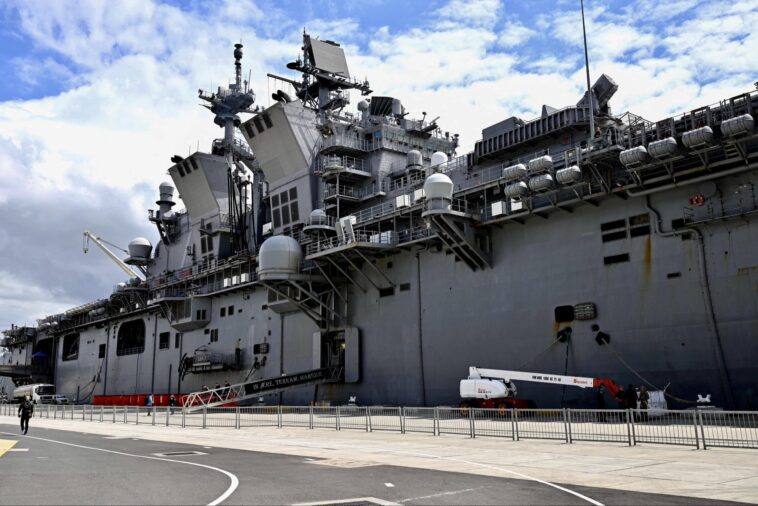
USS Tripoli, an America-class amphibious assault ship displacing 45,000 tons, is steaming from its forward base in Sasebo carrying the 31st Marine Expeditionary Unit: 2,500 Marines, up to 20 F-35B stealth fighters capable of vertical landing on its deck, MV-22 Ospreys, CH-53K heavy-lift helicopters, AH-1Z attack helicopters, and the ground combat element that makes an MEU the most versatile rapid-response force on Earth.
Arrival in the Middle East: one to two weeks. Fox News confirmed from a defence official. The Wall Street Journal reported the deployment was requested by CENTCOM and approved by Hegseth.
Three carrier strike groups are already deployed. Ford in the Red Sea, catching fire in its laundry. Lincoln in the Arabian Sea, subject to fabricated engagement reports. Truman supporting from the eastern Mediterranean.
Combined: over 200 aircraft, 20,000 sailors, and the most concentrated naval firepower since the Gulf War. And it is not enough. Because carriers do three things: launch aircraft, defend themselves, and project power from the sea.
They do not clear mines. They do not escort tankers through a 33-kilometre gauntlet. They do not insert special forces into granite mountains. They do not seize uranium.
The Tripoli does something the carriers cannot. It carries Marines.
The F-35B is the only fifth-generation stealth fighter that can take off from a short deck and land vertically. It does not need a catapult or an arresting wire. It needs 600 feet of flat deck, which the Tripoli provides. In a surge configuration, Tripoli becomes a “Lightning Carrier,” launching stealth sorties over Hormuz for air superiority, SEAD against IRGC coastal missile batteries, and anti-ship strikes using the LRASM, a long-range anti-ship missile with a 200-nautical-mile standoff range tested on the F-35B in March 2025. The aircraft that Iran cannot see on radar can destroy the coastal batteries that Iran uses to threaten tankers without entering the range of the shore-based missiles defending them.
But the F-35Bs are not why the Tripoli was sent. The Marines are.
An MEU carries a ground combat element: infantry, reconnaissance, engineers, explosive ordnance disposal, and the organic helicopter lift to insert them anywhere within range.
The 31st MEU has trained for subterranean operations, amphibious assault, and hostage rescue. It is the outer ring of the mission architecture whose inner ring is a JSOC team walking into Pickaxe Mountain.
It is the Quick Reaction Force for the nuclear extraction that airpower alone cannot achieve. It is the mine-clearance escort that three carriers cannot provide because carriers do not carry mine countermeasure teams.
The deployment reveals what the briefings conceal. Hegseth stood at the podium this morning and said the war is being won. Missile volume down 90%. Drone volume down 95%. Navy at the bottom of the gulf. Defence industrial base destroyed.
Then he approved 2,500 Marines sailing from the Pacific because winning from the air has not opened the Strait, has not cleared the mines, has not reached the uranium, and has not produced a single tanker escort.
The Tripoli is the answer to the question the carriers cannot solve: what happens when the enemy is underground, the waterway is mined, the insurance is cancelled, and the President told the tankers to show some guts? You send Marines. Because Marines do not fly over the problem. They walk into it.Get The Full, Details. .
Get Breaking News Before Everyone Else — Join Our Whatsapp Channel Now!!!
𝗙𝗼𝗹𝗹𝗼𝘄 𝗢𝘂𝗿 𝗪𝗵𝗮𝘁𝘀𝗔𝗽𝗽 𝗖𝗵𝗮𝗻𝗻𝗲𝗹 𝗧𝗼 𝗚𝗲𝘁 𝗟𝗮𝘁𝗲𝘀𝘁 𝗡𝗲𝘄𝘀 𝗔𝘀 𝗜𝘁'𝘀 𝗗𝗿𝗼𝗽!