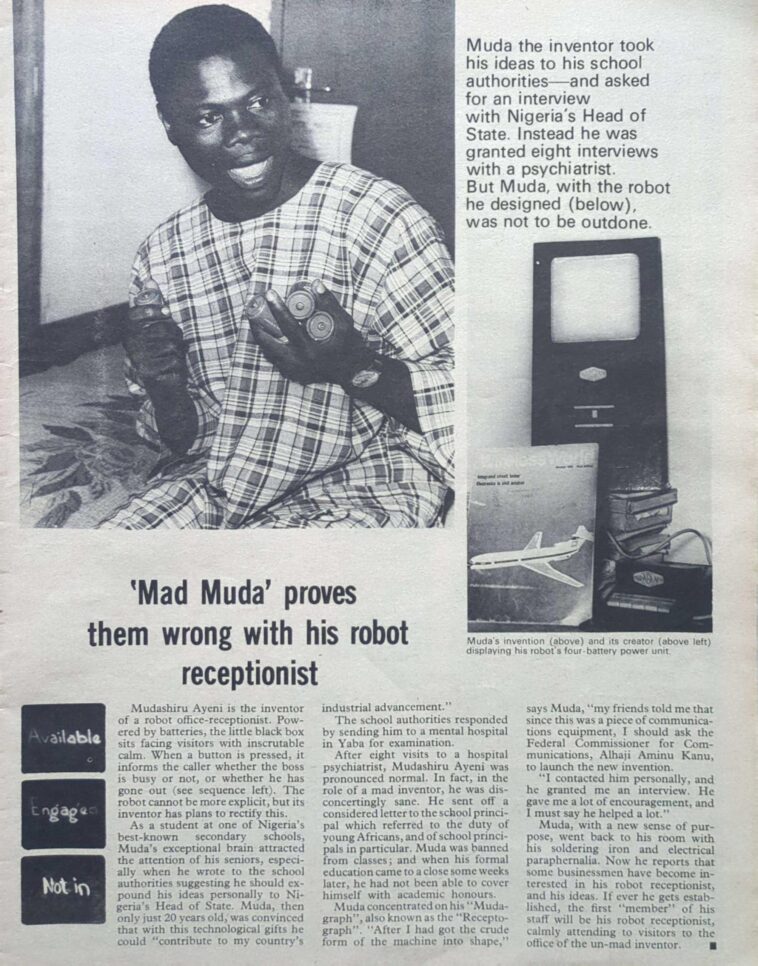
Long before Artificial Intelligence became a global phenomenon, a 20-year-old Yoruba student named Mudashiru Ayeni had already built a battery-powered robot office assistant. His invention? A machine that could tell callers whether the boss was busy, available, or away from the office at the press of a button.
But instead of being celebrated as a genius, Ayeni was treated like a madman.
According to a 1971 feature story by TRUST magazine, Ayeni requested a personal demonstration before Nigeria’s then-Head of State, General Yakubu Gowon. His reward? He was sent to a psychiatric hospital for evaluation.
· Ayeni made eight visits to the psychiatric hospital before a doctor finally certified him to be of sound mind.
· He wrote to his school principal about the role young Africans should play in the continent’s development, and was banned from classes and forced to quit school entirely.
Ayeni later reached out to Nigeria’s Federal Commissioner of Communications, Aminu Kano, who encouraged him and gave him renewed purpose. At the time the story was published, several businessmen had already expressed interest in his invention.
While the world celebrates AI pioneers, Mudashiru Ayeni’s story remains a painful reminder of how Nigeria treated Yoruba genius, with suspicion, humiliation, and psychiatric wards instead of laboratories and funding.
Get Breaking News Before Everyone Else — Join Our Whatsapp Channel Now!!!
𝗙𝗼𝗹𝗹𝗼𝘄 𝗢𝘂𝗿 𝗪𝗵𝗮𝘁𝘀𝗔𝗽𝗽 𝗖𝗵𝗮𝗻𝗻𝗲𝗹 𝗧𝗼 𝗚𝗲𝘁 𝗟𝗮𝘁𝗲𝘀𝘁 𝗡𝗲𝘄𝘀 𝗔𝘀 𝗜𝘁'𝘀 𝗗𝗿𝗼𝗽!