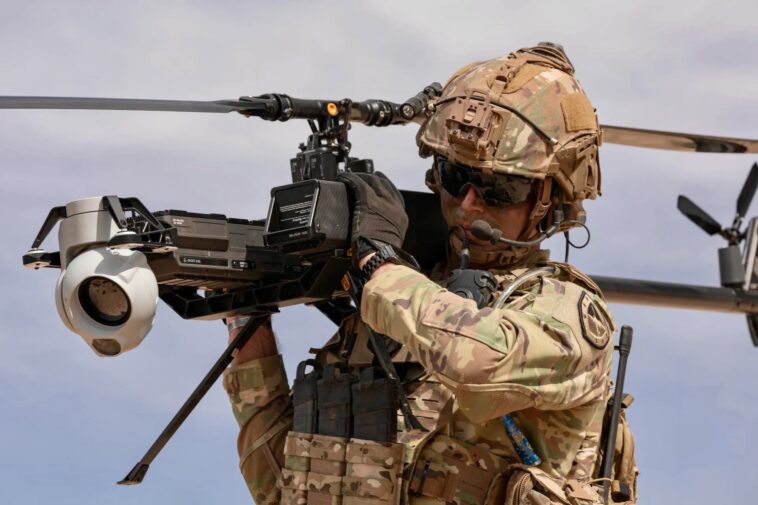
Anduril Industries received the largest enterprise contract in modern Army procurement history on 13 March for Lattice, its AI-powered command-and-control platform that fuses thousands of sensor feeds into a single real-time battlespace map, tasks autonomous drone swarms, and enables one operator to control what previously required dozens.
The contract covers software, hardware, data infrastructure, compute, and services consolidated into a unified counter-drone capability. The Army did not buy a weapon. It bought an operating system for war.
The operating system was written in Ukrainian rubble.
Anduril deployed hundreds of Altius loitering munitions and Ghost reconnaissance drones to Ukrainian forces starting in 2024.
The early results were catastrophic. Russian electronic warfare, the most sophisticated jamming environment on Earth, tore them apart. GPS spoofing sent Ghost drones spiralling into the ground.
Persistent jamming reduced general drone hit rates to 10 to 15%. Altius units crashed before reaching targets.
Ukrainian operators, who were simultaneously building their own drones at a rate of one million per year with 96% indigenous production, were unimpressed.
Anduril did something most defence contractors do not. It sent engineers to the front line, collected operator feedback in real time, and redesigned the aircraft in months rather than years.
The result was Ghost-X: a fundamentally different machine. Where the original Ghost relied on GPS, Ghost-X flies on vision. Onboard computer vision algorithms, optical flow sensors, and terrain mapping through electro-optical and infrared gimbals give the aircraft autonomous navigation in environments where every satellite signal is jammed.
It does not need GPS because it can see. It does not need a datalink because Lattice gives it mission autonomy. It does not need a dedicated operator because one person can task an entire swarm.
Ghost-X proved, in Anduril’s words, “markedly more resilient” in both Ukrainian combat and US Government electronic warfare testing.
The drone that crashed in a jammed Ukrainian field became the drone that flies through jammed airspace without flinching. The $20 billion contract is the Army’s bet that what survived Russian EW can defeat Iranian Shaheds.
The Iran war is the contract’s first test at scale. IRGC one-way attack drones are down 95% according to Hegseth’s briefing, but they are not gone.
The Mosaic Doctrine’s 31 autonomous commands can still launch from dispersed positions using the simplest guidance systems available.
The coastline that produces fast boats also produces cheap drones that do not need to be sophisticated to overwhelm. Lattice’s counter-UAS architecture, AI-fused radar and electro-optical data identifying threats in seconds, autonomous interceptors engaging without human delay, single operators managing swarm responses across the battlespace, is designed for exactly this: volume.
The contract also reveals what the Army learned from Ukraine that it will not say publicly. Indigenous Ukrainian interceptors achieved 70% success rates against Russian drones in February 2026, built cheaply, iterated rapidly, and deployed at scale by operators who learned electronic warfare the hard way.
The Army watched a country with a fraction of America’s budget outperform imported systems by iterating faster.
The $20 billion is not just a purchase. It is an admission that the future of air defence is software-defined, AI-driven, and built by companies that treat combat data as a product cycle rather than a procurement milestone.
Anduril’s drones crashed in Ukraine. Then they learned to see. Now the Army is betting $20 billion that seeing is enough to win a war where everything that depends on a satellite signal dies.Get The Full, Details. .
Get Breaking News Before Everyone Else — Join Our Whatsapp Channel Now!!!
𝗙𝗼𝗹𝗹𝗼𝘄 𝗢𝘂𝗿 𝗪𝗵𝗮𝘁𝘀𝗔𝗽𝗽 𝗖𝗵𝗮𝗻𝗻𝗲𝗹 𝗧𝗼 𝗚𝗲𝘁 𝗟𝗮𝘁𝗲𝘀𝘁 𝗡𝗲𝘄𝘀 𝗔𝘀 𝗜𝘁'𝘀 𝗗𝗿𝗼𝗽!