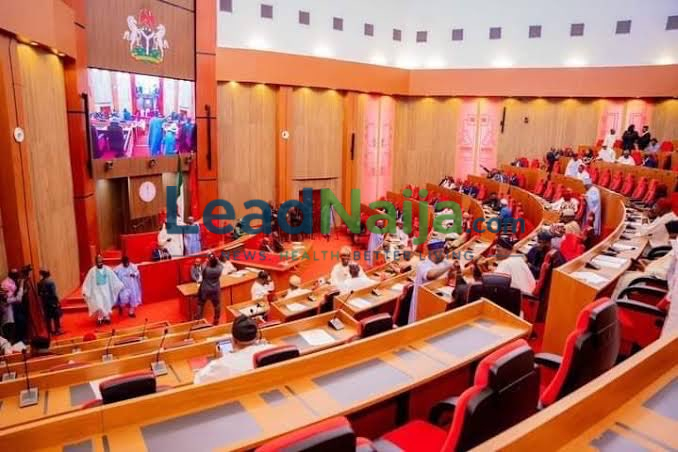
The Senate on Wednesday passed the long-awaited constitutional alteration bill seeking the establishment of State Police across Nigeria, in what lawmakers described as a major step toward tackling insecurity and deepening federalism.
The 25-clause bill provides the legal framework for the creation of State Police Services by states and also includes constitutional safeguards aimed at preventing abuse of police powers by governors and other political actors.
Leading debate on the bill, Senate Leader Opeyemi Bamidele said the legislation was carefully designed to address fears that governors could misuse state-controlled police formations to harass political opponents, intimidate dissenting voices, or suppress opposition parties.
To guard against this, the bill expressly prohibits any governor from directing a State Police Service to unlawfully target any person, political party, group, or association.
It also bars the use of police powers for partisan, ethnic, religious, sectional, or personal interests.
A major feature of the bill is the framework for federal intervention in exceptional cases.
The Federal Government may intervene where there is a breakdown of public order, where a State Police Service becomes incapable of functioning, where there are serious abuses of fundamental rights, cases of partisan or electoral intimidation, or threats to national security.
Such intervention must be authorised in writing by the President, stating the grounds, territory, functions, and duration of the intervention.
Notice must also be sent within 48 hours to the state governor, Speaker of the State House of Assembly, National Police Council, and the National Assembly.
The bill also empowers the National Assembly to set national minimum standards for both federal and state police institutions, covering recruitment, training, vetting, promotion, discipline, use of force, and handling of firearms.
Under the new structure, the current constitutional provision establishing only the Nigeria Police Force would be replaced with a dual policing system comprising a Federal Police Service for the federation and a State Police Service for any state that chooses to establish one through legislation passed by its House of Assembly.
However, the Senate made it clear that State Police will not come into existence automatically.
Any state seeking to establish its own police service must first pass a law creating it, and the proposed force must be certified as meeting national minimum standards prescribed by the National Assembly.
The bill also clearly outlines the responsibilities of the Federal Police Service, including the protection of federal institutions, policing of the Federal Capital Territory, counter-terrorism, organised crime investigations, cybercrime, border security, arms trafficking, inter-state criminal activities, and other matters affecting national security.
According to the Senate, the bill is expected to improve community policing, ensure faster response to security threats, and ease the burden on federal security agencies, allowing the Federal Police Service to focus on terrorism, organised criminal networks, and other crimes that cut across state boundaries.
The passage of the bill comes amid growing calls for decentralisation of policing powers as part of broader efforts to address Nigeria’s security crisis.
The Senate passed the constitutional alteration bill on State Police clause by clause as it was sent by President Bola Tinubu.
The next phase of the process will be harmonisation with the House of Representatives to agree on areas where both chambers passed different versions of the bill.
Thereafter, the bill will be transmitted to the State Houses of Assembly for further action in line with the constitutional amendment process.
Get Breaking News Before Everyone Else — Join Our Whatsapp Channel Now!!!
𝗙𝗼𝗹𝗹𝗼𝘄 𝗢𝘂𝗿 𝗪𝗵𝗮𝘁𝘀𝗔𝗽𝗽 𝗖𝗵𝗮𝗻𝗻𝗲𝗹 𝗧𝗼 𝗚𝗲𝘁 𝗟𝗮𝘁𝗲𝘀𝘁 𝗡𝗲𝘄𝘀 𝗔𝘀 𝗜𝘁'𝘀 𝗗𝗿𝗼𝗽!