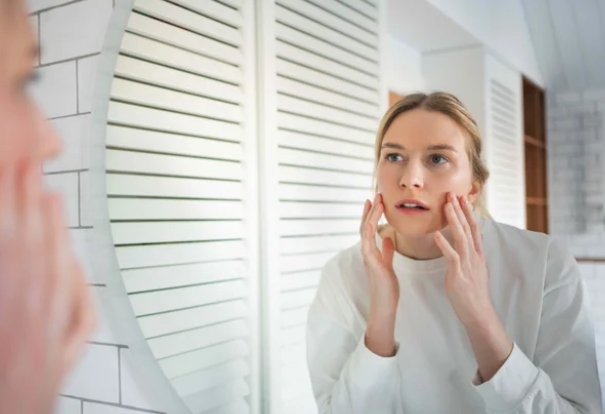
When your thyroid is out of balance, your skin and eyes are often the first places you notice symptoms.
The specific changes depend on whether your thyroid is not making enough hormones (hypothyroidism) or making too many (hyperthyroidism).
1. Cool, Dry Skin
Your thyroid hormones help regulate how quickly your skin grows, repairs, and retains moisture. When your thyroid levels are off, these processes slow down or speed up.
If you have hypothyroidism, your thyroid doesn’t make enough hormones, slowing everything down. A slower metabolism and less blood flow can make your skin feel cool.
Your skin also gets dry because it produces less oil and sweat. Dry skin is the most common skin change, affecting more than half of those with hypothyroidism.
Moisturizer may help, but your skin likely will not fully improve until you receive treatment and your thyroid hormone levels are back to normal.
2. Rough, Flaky Skin
An underactive thyroid slows down skin cell turnover. This causes a buildup of dead skin cells and flaky, rough, or thick patches, especially on your elbows, palms, knees, and heels.
In rare cases, you may get thick, bumpy skin on the palms of your hands and the soles of your feet. Another rare possibility is the development of large, thick, fish-like scales.
Standard topical (skin) treatments may not be effective. However, your skin will likely improve with thyroid medications once your hormone levels rebalance.
3. Warm, Thin, Smooth Skin
Hyperthyroidism causes excess thyroid hormones, speeding everything up. This includes an increase in your metabolism and blood flow, making your body generate extra heat.
You will likely feel sweaty even when you’re resting, and your skin will feel warm and damp. Your dead skin cells also shed more quickly, causing thin, smooth, and soft skin.
4. Swelling
An underactive thyroid can cause myxedema, a type of swelling that makes your face, eyelids, lips, or hands look puffy. This happens when substances build up in your skin and cause it to hold onto fluid.
This swelling typically feels firm or doughy and does not leave an indent when you press it. Your face may look fuller, even without weight gain, and your features may appear blurred.
With an overactive thyroid, swelling is less common, but you may notice some in your hands.
In Graves disease (the most common cause of hyperthyroidism), you may develop pretibial myxedema. This causes reddish, tender, and firm swelling on your shins. It may appear scaly or waxy, with an orange-peel texture.
5. Pale or Yellow Skin
With hypothyroidism, poor blood circulation and a slower metabolism can cause your skin to look pale. In severe cases, you may see a blotchy, reddish-blue, net-like pattern on your skin that gets worse when you are cold. You may also notice vitiligo, which causes lighter patches of skin on your face, hands, or joints.
Low thyroid hormone levels can also cause a yellowish skin tint (carotenemia), especially on your palms, soles, or around your nose.
This happens when your body struggles to convert carotene, the pigment found in carrots, into vitamin A. The carotene builds up and tints your skin.
This yellowing may look like jaundice. But with carotenemia, the whites of your eyes stay normal, unlike with jaundice, where your eyes also turn yellow.
6. Red or Dark Skin
With an overactive thyroid, your circulation increases. In addition to feeling hot or sweating a lot, your skin may get red, especially on the palms of your hands and the soles of your feet. Some people develop hyperpigmentation, which causes darker patches of skin.
7. Itching, Hives, and Rashes
Both hypothyroidism and hyperthyroidism can cause itching, an ongoing rash, or hives (sometimes lasting more than six weeks).In one study, itching affected about 76% of people with hypothyroidism.
8. Eye Swelling
An underactive thyroid can cause fluid retention, leading to swelling or puffiness around the eyes known as periorbital edema. This is often mistaken for allergies. You may also have drooping upper eyelids (ptosis).
9. Yellow Plaques Around Your Eyelids
With hypothyroidism, you may develop xanthelasma. This shows up as soft, yellow plaques around your eyelids, especially near the inner corners.
10. Retracting Eyelids
With an overactive thyroid, you may notice your eyelids retract or lag. This means that your eyelids don’t close fully, which can make your eyes look wide or give a staring or surprised appearance.
11. Bulging Eyes
With Graves’ disease, which can cause hyperthyroidism, you may develop a condition called thyroid eye disease.
This results in bulging eyes (proptosis) due to swelling or pressure behind your eyes. You might also experience double vision, watery eyes, and red or bloodshot eyes..
12. Eyebrow and Eyelash Loss
If your thyroid is underactive, the outer third of your eyebrows may slowly thin or disappear. Eyelash loss can also occur, but it is less common.
Hair and Nail Changes
Thyroid imbalances can also affect your hair and nails.
Hair Changes
If you have an underactive thyroid, your hair may feel dry, coarse, and brittle. It may also shed easily.
Up to 50% of people with hypothyroidism experience hair thinning across their scalp. It may get worse briefly after you start treatment but then improve.
Some cases of hypothyroidism cause more hair to grow on your back and shoulders, though this is less common and specific to children.
With an overactive thyroid, your hair may be fine, soft, and thinner, with increased shedding.
It could also look banded or speckled, with light and dark sections along the strands, but this is rare.
Nail Changes
With hypothyroidism, your nails may grow more slowly and may become brittle, thick, or ridged.
If you have an overactive thyroid, your nails may grow faster but feel soft and fragile.
You may also see ridges or separation of the nail from the nail bed (onycholysis).
Get Breaking News Before Everyone Else — Join Our Whatsapp Channel Now!!!
𝗙𝗼𝗹𝗹𝗼𝘄 𝗢𝘂𝗿 𝗪𝗵𝗮𝘁𝘀𝗔𝗽𝗽 𝗖𝗵𝗮𝗻𝗻𝗲𝗹 𝗧𝗼 𝗚𝗲𝘁 𝗟𝗮𝘁𝗲𝘀𝘁 𝗡𝗲𝘄𝘀 𝗔𝘀 𝗜𝘁'𝘀 𝗗𝗿𝗼𝗽!