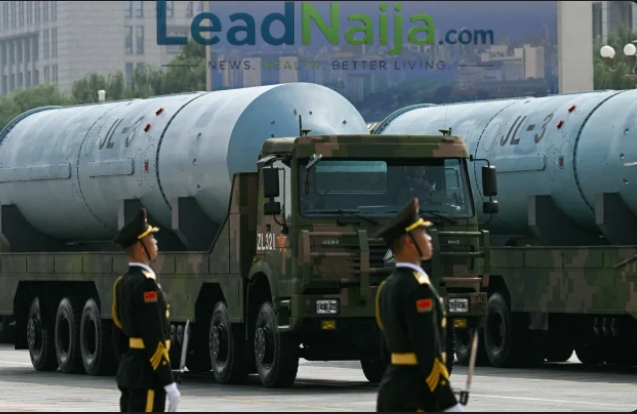
China has defied warnings and fired an Intercontinental Ballistic Missile (ICBM) from a nuclear-powered submarine in the South Pacific.
The missile, carrying a dummy warhead, marked China’s first missile test in the Pacific in two years and came only hours after Australia signed a defence agreement with Fiji, committing to come to the other’s aid in the event of an attack.
Beijing sent out routine notifications to neighbouring countries a few hours before the launch, provoking concern and leading to pleas to abandon the tests.
Japan’s defence and foreign ministries immediately issued a joint statement revealing they “strongly called for a rethink of the ballistic missile test-firing”.
Australia and New Zealand condemned the test, with Penny Wong, Australia’s foreign minister, calling it “destabilising” to the region, and Winston Peters, her New Zealand counterpart, “deeply concerning”.
New Zealand said it had been informed of the planned launch hours beforehand, and noted that the missile was fired into the South Pacific Nuclear Free Zone.
China took no notice.
“The missile landed accurately in the designated area,” a report from Xinhua, China’s official news agency, said.
It said the launch took place at 12.01pm Beijing time, describing it as routine military training that “was not directed against any specific country or target”.
Experts said the launch was an example of aggression intended to demonstrate China’s growing nuclear capabilities and send a political message to rivals.
On Monday, LeadNaija News report Australia and Fiji signed a major defence treaty, the latest in a string of agreements as Canberra seeks to push back against China’s encroachment in the region.
Anthony Albanese, the Australian prime minister, signed the pact with his Fijian counterpart Sitiveni Rabuka during a trip to the capital, Suva.
Widely seen as an effort to counter Chinese influence in the Pacific, the treaty binds each nation to come to the other’s “mutual defence”.
Mr Rabuka tried to quell concerns that China could see the treaty as a snub. “I do not expect China to have any severe pushback,” he told reporters.
While Beijing did not identify the missile, analysts believe it was probably the JL-3, a submarine-launched intercontinental ballistic missile which was displayed during a military parade in Beijing in 2025.
China’s previous long-range missile test, in September 2024, landed near French Polynesia and was the country’s first Pacific ICBM launch in more than four decades.
Mr Peters, New Zealand’s foreign minister, described the test as an “unwelcome and concerning development”.
He added: “We, like our neighbours in other Pacific countries, have no interest in China using the South Pacific as a testing site for missile capability.”
But Russia defended the test by its ally, calling it a “sovereign right” of the country.
Dmitry Peskov, Kremlin spokesman, said on Monday: “We believe it is the sovereign right of China to test its missiles. China is not threatening anyone in the world.”
William Yang, Crisis Group’s senior analyst for North East Asia, said the ICBM test served several purposes.
He said: “It demonstrates the progress in China’s advanced missile capabilities, sends a signal to regional countries, including Australia and other Pacific states, about Beijing’s ability to respond resolutely to what it views as a challenge to its interests, and allows the PLA [People’s Liberation Army] to maintain regular military drills across the Asia Pacific region.”
Frank Ledwidge, a former military intelligence officer and senior lecturer in war studies at Portsmouth University, said the launch was not a routine test but a political signal about China’s strategic capabilities.
He told The Telegraph: “The previous Chinese missile nuclear missile launch was in 1982 so you go from 1982 to 2024 without any ballistic missile test launch. They say it is a routine test. These are never routine tests. There have only been two ever, so that’s the first thing.”
He added: “So what’s the political message? The previous message was, we’ve got this missile, and we’re prepared in the technical sense to use it. It works, and it works at range, which means we can hit you. If we can hit, in this case, the Central Pacific, we can hit you, wherever that is. That’s the message of the 2024 launch.”
Now, he added, Beijing was sending out a message that said: “Not only can we do this once, we’ve done it twice now, which means that the system works properly. From a Chinese military perspective that’s the most important message.”
He added that neither of Britain’s previous two ballistic missile tests had worked.
Anthony Glees, security and defence expert from the University of Buckingham, added that testing an ICBM that can be fired from a submarine means China “now represents a grave threat to the stability of the entire Asia-Pacific”.
He added: “Our strong allies in the Asia-Pacific, Australia and New Zealand in particular are in no way a threat to China, they have nothing that needs to be deterred by China.
“So these tests have clear aggressive intent. We are all under challenge from them.
“In bullying the peaceful nations of the Asia Pacific who represent no threat to China, we need to understand that we, too, are being bullied by Xi’s absolute projection of power in the region.”
Get Breaking News Before Everyone Else — Join Our Whatsapp Channel Now!!!
𝗙𝗼𝗹𝗹𝗼𝘄 𝗢𝘂𝗿 𝗪𝗵𝗮𝘁𝘀𝗔𝗽𝗽 𝗖𝗵𝗮𝗻𝗻𝗲𝗹 𝗧𝗼 𝗚𝗲𝘁 𝗟𝗮𝘁𝗲𝘀𝘁 𝗡𝗲𝘄𝘀 𝗔𝘀 𝗜𝘁'𝘀 𝗗𝗿𝗼𝗽!